
Brick Books → Guides → Stocktake, and Why Your Profit Looks Wrong
One of the most common mistakes in reseller bookkeeping, and the year-end step that fixes it.
For a reseller, stock can make the difference between books that tell you something useful and books that give you completely the wrong impression.
It is also something your accountant is very likely to ask about.
Say you spend $5,000 on LEGO® and sell none of it before the year ends.
Have you really made a $5,000 loss?
Not necessarily. You have turned $5,000 of cash into stock that the business still owns. The money has not simply disappeared, it is sitting on the shelf instead of in the bank.
That is why stock bought for resale is treated differently from an ordinary running cost.
As stock is sold, its cost becomes part of the cost of making those sales. What remains unsold at year end is carried forward as stock rather than simply disappearing into that year's expenses.
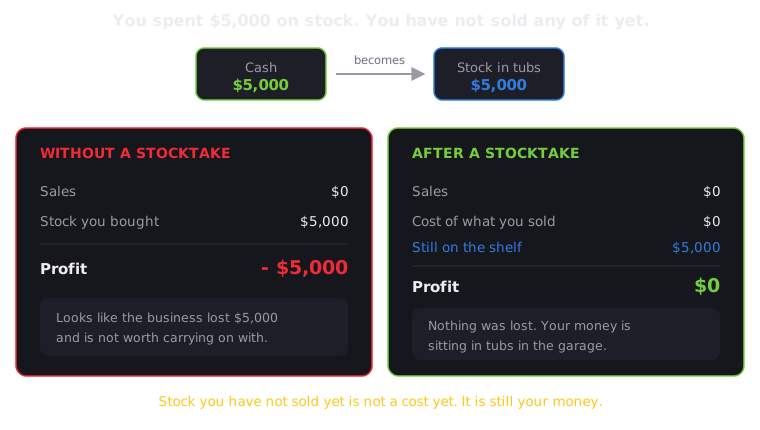
Until Brick Books knows what is still sitting on the shelf, purchases of resale stock can make your profit look much worse than the business really performed.
A perfectly decent year in which you bought heavily for the future can suddenly look like a disaster.
For a lot of sellers, the missing money is not actually missing at all.
It is in drawers, tubs, shelves and half-sorted bulk lots.
Work out the cost of the stock you still hold, not what you hope to sell it for.
If you paid $200 for a bulk lot and, using your normal stock valuation method, half of that cost belongs to items still unsold at year end, your remaining stock from that lot would be $100.
Open the Stocktake screen and enter your closing stock figure.
If you have earlier years for which you know the correct closing stock, those can be entered there too.
Brick Books recalculates the year using the stock figure you entered.
This is often the point where a reseller's profit suddenly starts looking much more like the year they remember having.
For a LEGO® seller, stocktake does not necessarily mean individually valuing every loose brick in the building.
What matters is having a reasonable, consistent way of working out the cost of the stock you still hold, and being able to explain how you arrived at the figure.
If you buy bulk lots, that might involve allocating the original purchase cost across what has sold and what remains.
The important part is consistency.
The exact rules for valuing and counting trading stock vary between countries, and some tax systems have simplified rules or concessions for smaller businesses.
Brick Books does not guess which rules apply to you.
If you are unsure how your stock should be valued for tax or year-end reporting, ask your accountant and use the method they want you to use.
This year's closing stock becomes next year's opening stock automatically.
Nothing disappears, and the same stock is not counted twice.